Managed IT Services
SRE-grade reliability, AIOps-powered operations
We run your platform like a high-performing engineering team, not a traditional helpdesk. AIOps-driven monitoring, SRE practices, and automated incident response keep your systems reliable, observable, and continuously improving.
What We Deliver
Core Capabilities
- AIOps — Predictive Monitoring & Anomaly Detection
- Site Reliability Engineering (SRE) as a Service
- Automated Incident Response & Runbook Automation
- Observability — Metrics, Logs & Distributed Tracing
- SLA-Backed Uptime Guarantees
- 24/7 NOC & Escalation Management
Ready to get started?
Get a free technical brief — architecture options, timelines, and cost estimates delivered within 48 hours. No commitment required.
- 01Submit your challenge≈ 1 min
- 02Receive your Technical BriefWithin 48h
- 03Discovery call — no obligationOptional
Or call us: +1 (929) 588-8364
By the Numbers
What clients achieve with GYSP
across managed clients in production, enforced by AIOps anomaly detection and automated runbook execution, not reactive firefighting
after deploying automated incident response playbooks, issues are classified, triaged, and resolved before most teams notice
predictive monitoring catches degradation patterns before they become outages, reactive ops becomes proactive engineering
Where is your engineering capacity actually going?
12 questions. ~5 minutes. Get a velocity score (1–5, DORA-based) and a dollar estimate of engineering capacity consumed by delivery friction — CI bottlenecks, tech debt, incidents, and review delays.
Proven Results
Managed IT Case Studies
 Telecom
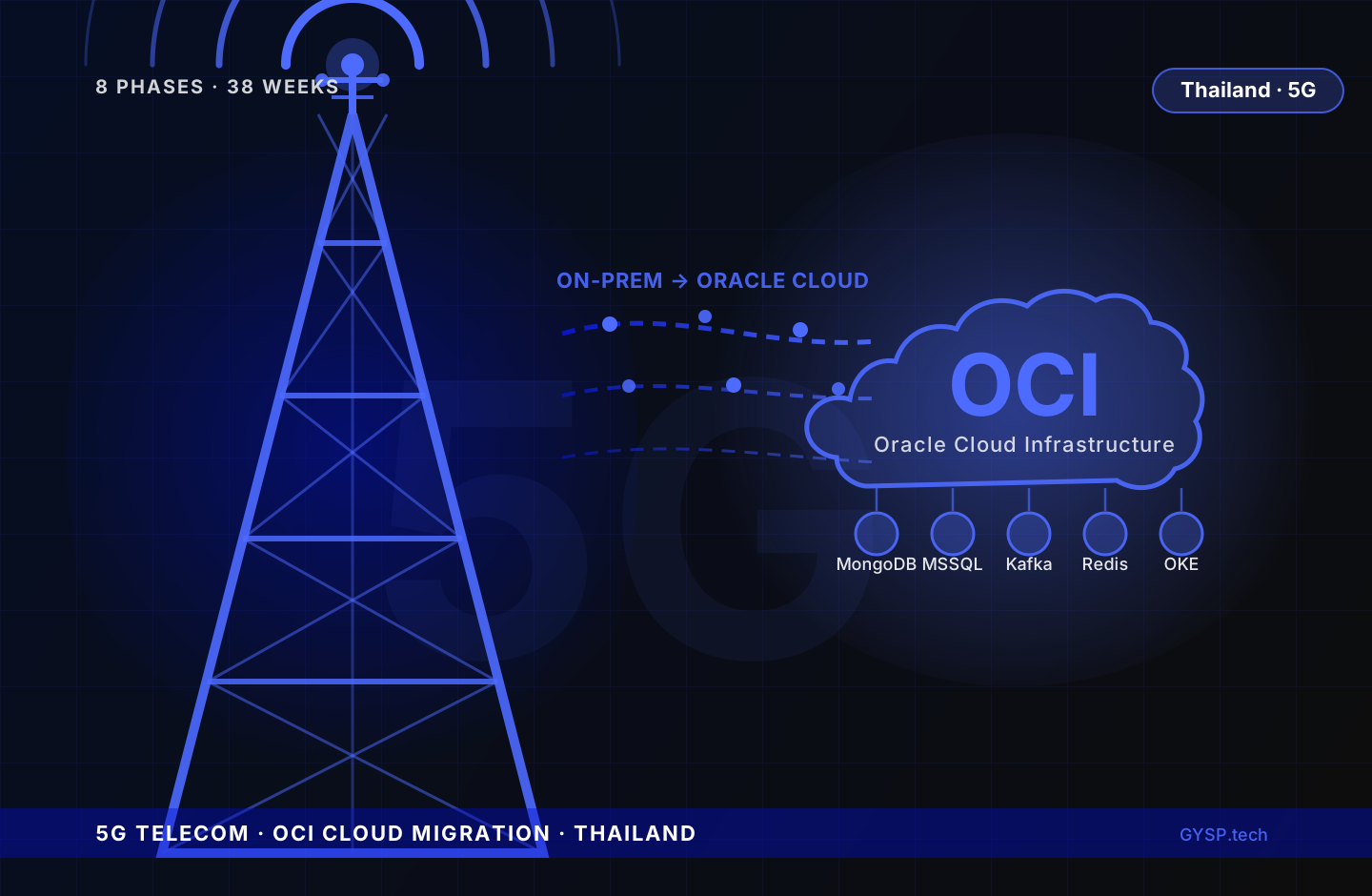
5G Telecom Giant, Thailand
A national 5G telecom leader in Thailand needed to migrate an entire on-premises platform to Oracle Cloud Infrastructure, across four heterogeneous data systems, with zero production downtime, and a mandate to build a reusable blueprint for 11 more sites to follow.
 TravelTech
Expedia India
Manual deployments, peak-season exposure, and reactive monitoring, at the scale of millions of daily travel bookings. The infrastructure needed to match the ambition.
 TravelTech
OYO
Legacy infrastructure, idle cloud spend, DDoS vulnerability, and manual deployments were compounding simultaneously for one of the world's fastest-growing hospitality brands. GYSP tuned Kubernetes auto-scaling to eliminate idle capacity on GCP GKE, driving a 30% cost reduction while achieving 99.98% platform uptime.
Industry Expertise
Industries We Serve with Managed IT
Client Voices
What our clients say
“The GYSP team completely transformed our infrastructure. Moving from a monolith to microservices, full observability, compliance. All while keeping costs predictable, which I honestly didn't think was possible at the same time. Teachers and students got faster, more reliable access and our dev team finally had real velocity. More partner than vendor.”
“We'd accumulated three years of technical debt that was starting to show in reliability. GYSP ran a strangler-fig migration — new services in parallel, traffic migrated incrementally — with zero downtime to clinical users. The platform now holds 99.97% uptime, which matters when clinicians depend on it around the clock.”
“Our order management system was costing us enterprise clients. GYSP rebuilt the integration layer — WMS, carrier APIs, client systems — with automated exception handling and real-time SLA monitoring. Error rates fell from 4.1% to 0.2%. We've onboarded seven enterprise accounts in the six months since the rebuild.”
FAQs
Common questions
Everything buyers typically ask before starting a managed it engagement.
Ask us anythingHow is SRE-as-a-Service different from a traditional Managed Service Provider?
Traditional MSPs react to incidents. SRE as a service is proactive, with error budgets, SLOs, blameless post-mortems, and continuous reliability improvement. We instrument everything, predict failures before they happen with AIOps, and treat reliability as an engineering discipline, not a helpdesk function.
What does AIOps actually mean in practice?
AIOps uses ML models to analyse your metrics, logs, and traces and surface anomalies before they become incidents. In practice: noise-reduced alerting, automated root cause suggestions, and predictive capacity alerts. Your on-call engineer gets a notification with a probable cause and suggested runbook, not a pager blast at 3am with no context.
What SLA uptime guarantees do you offer?
We commit to 99.95% uptime SLA (4.3 hours downtime per year) as standard, with 99.99% available for Tier 1 production systems with active-active multi-region architecture. SLAs are backed by financial credits and measured against your actual user-facing availability.
How do you handle incident response and escalation?
All incidents follow a defined playbook: detect → classify → acknowledge (within 5 minutes for P1) → diagnose → mitigate → resolve → post-mortem. Escalation paths are pre-agreed per client. You always know who is handling what and when.
Can you take over management of infrastructure you didn't build?
Yes, and we do this regularly. We start with a 2-week discovery phase: inventory, instrumentation audit, runbook documentation, and risk assessment. By week 3 we're monitoring live. By week 8 we've closed the highest-risk gaps and are operating to full SRE standards.
Let's build something together
Get a free technical brief on your managed it challenge — architecture, timeline, and cost estimate in 48 hours.
Get Free Technical Brief